Showing posts with label Pi. Show all posts

Monday, July 8, 2013

Factorials - A Look At Infinity.

Share this ARTICLE with your colleagues on LinkedIn .


n!

If I asked you for the sum of the integers from 1 to 100 inclusive, you could solve the problem by an easy formula [ref.: formula for the sum of an arithmetic series]. But if I asked you for the product of all of the integers from 1 to 100 (or 100!, as this is written), if you didn't have a shortcut you'd come back to me 3 days and several gallons of Red Bull [I hate the stuff] later -- and odds are, if you did the calculation manually, you've introduced at least one error, which makes your result a study in 1) discipline and devotion; and 2) high unreliability.

Happily, over the years, mathematicians have pondered this problem and found a formula to approximate the result. Note that the factorial formula is increasingly accurate as the amount of numbers multiplied grows, i.e., the formula would be rotten for calculating 10!, poor for 100!, passable for 1,000! and very darn close and useful for 10,000! Now "here", as the ignorami [a Lingovation of the highest order, and not to be confused with the Order Of The Illuminati, lest they get ticked off and do terrible things to you -- like having you mentioned in a Dan Brown -- uggggh -- novel] amongst us are wont to say, is "the beauty part":

Calculating factorials

The numeric value of n! can be calculated by repeated multiplication if n is not too large. That is basically what pocket calculators do. The largest factorial that most calculators can handle is 69!, because 70! > 10100.

When n is large, n! can be estimated quite accurately using Stirling's approximation:
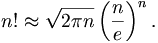
You can actually do the above (if you are lazy, as I am), by using a generator available right on the internet!***

Where Pi = Fraction: 22/7. Decimal: 3.14 - or - 3.141592653589793238462643... and,
Where e =  2.71828
___________________________________________________________________________

Factorials can be useful to facilitate expression manipulation. For instance the number of k-permutations of n can be written as
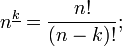
while this is inefficient as a means to compute that number, it may serve to prove a symmetry property of binomial coefficients:


Okay, Braintenancers, Mind Expanders, Brain Trainers, And Cognition Expanders:

Here is a generator which you can use to further shortcut Stirling's brilliant (but still somewhat hairy) formula:

Click on either of these little mamas and simply plug in your data:

http://www.nitrxgen.net/factorialcalc.php

http://www.kalkulacka-online.com/faktorial.php?l=en

As always, thank you for reading me, and for sharing my articles with your colleagues and connections across your social media platforms using you ever-increasing collection of social media sharing tools.

Douglas E. Castle


View DOUGLAS E. CASTLE's profile on LinkedIn

Douglas E Castle
All Blogs & RSS Feeds

Share this page
Contact Douglas Castle
Follow Me on Pinterest


CFI, C.F.I., CrowdFunding Incubator,  crowdfunding, crowd funding, incubators, accelerators, finance projects, listing services, start up, small business, SME, funding, capitalization, financing, leverage, company services, management, marketing, fundraising, technology, mentoring, advice, media, branding, memes, business tips tricks tools and resources, entrepreneur, forum, discussion, applications, technologies, risk assessment, business model, strategic planning, organizational development, connections, networking, early-stage, first-round, angel  funding, venture capital, credit lines, assistance, business growth, biz builders, social media power, delegation, automation, monitoring, metrics, brainstorming, meetups, joint ventures, partnerships - http://CFICrowdFundingIncubator.blogspot.com, http://www.CrowdFundingIncubator.com, marketing, messaging, news releases, free, gain market share, increase backlinks, SEO, influence, disruption theory, directory, RSS feeds, Douglas E. Castle, blogroll, blogs, crowdfunding blogs...


***
View DOUGLAS E. CASTLE's profile on LinkedIn

Douglas E. Castle - Blogger Profile
CFI - Notes From The CEO
Instant Musical Counterpoint - Relax!


Tuesday, September 6, 2011

Asymptotes - Frustrating Problems With Unsatisfying Solutions.

Share this ARTICLE with your colleagues on LinkedIn .


Illustration of the conditional convergence of...Image via Wikipedia


In our last posting, we discussed the notion of asymptotes, and I posed two problems for your consideration. One involved the eventual (but unreachable) sum of a convergent series of numbers, and the other involving a ever-more troubling fraction. You can quickly refresh your memory by clicking on http://braintenance.blogspot.com/2011/09/asymptotes-closer-but-never.html, and by then hitting your browser's "BACK" button.

The answers are unsatisfying, but they were promised:

1) In adding the sum of the series 1 + 1/2 + 1/4 + 1/8....and so forth, the sum will eventually approach, but never quite reach a limit of 2.

2) In dividing (n-1)/n, as n increases, the value of the expression approaches, but never reaches 1.

There are examples of this type of complex conundrum in nature, in such things as trying to solve 22/7 (which is a never-ending decimal), and in determining the halflives of certain radioactive materials (isotopes), where one half of the material loses its radioactive potency over a certain period of time, but the residual amount keeps getting halved and never quite disappears.

I solemnly promise to offer you something more nifty in my next article. The idea is to tax your brain until it has to expand its capacity in order to solve increasingly complex problems.

Sadly (and speaking about interesting wordplay and punnery), taxing our brains , while making us brighter, still won't make up the federal deficit... Did I hear somebody groaning?

Douglas E Castle

Friday, August 12, 2011

Pi: A magical number (and easier to say than "Phi")

Share this ARTICLE with your colleagues on LinkedIn .


The number Pi is a mathematical constant. It represents the ratio of the circumference of a circle to its diameter. If you divide the circumference of any circle (or perfectly-formed, hand-tossed pizza) by its diameter (the measure of a straight line cutting the pizza in half), you will get Pi, which is equal to 22/7, or approximately 3.14. Now let's review Fabian's quandary, from a couple of days ago...

Background:

Fabian Focaccia (not his real name, which is Sal Monella)  is a struggling 'artist' who is working at a neighborhood pizzeria in Brooklyn, New York (not his real location, as he is in the Federal Witness Protection Program, but which is still the best geographical location to make a pizza purchase if you/ youse should ever get around to it) to pay his bills until he can sell one of his paintings. He is faced with a decision and needs your help. He has cardboard boxes for 'take out' pizza (this pizza parlor does a big take-out business -- even for Arizona...oops!) which are each three inches deep (irrelevant for solving this problem) and measure exactly 20 inches by 20 inches square.

The Pizza Box Puzzle (In Two Parts):

1) What is the circumference of the largest pizza (assume that it is hand-tossed and perfectly round) which can be placed in the box neatly, i.e., placing it flat without stuffing it in and distorting its perfect shape?

Answer: This is really just a circle inscribed in a square. Here's a picture:


As you can see, the diameter of the pizza must  be exactly 20" for it to fit snugly in the box. If that's the case, then the pizza would have a circumference equal to Pi times the diameter, or approximately 62.8".

and,

2) What is the circumference of the largest individual pie (out of two) which can be placed in the box if two pies of equal size are placed in a cardboard container of the same dimensions as in number 1, above?

Answer: This is very similar to the first question. But this time you've got to put two equally-sized pies in the box without mutilating them. Here's a picture:


The two pies, side by side, can still not have combined diameters greater than the 20" length of the box (some of you were going to try doing this using the hypotenuse obtained by cutting the box into two right triangles, but that doesn't work - ha!). Each of the two pies will have a diameter of 10", and each will have a corresponding circumference of 31.4".

BCNU soon.

Douglas E Castle
(http://aboutDouglasCastle.blogspot.com)

Don't forget to maintain that brain! Braintenance! (http://Braintenance.blogspot.com)

Enhanced by Zemanta

Wednesday, August 10, 2011

Pizza, Pi and Packaging.

Share this ARTICLE with your colleagues on LinkedIn .


Your mind is a muscle. You must use it to strengthen it. If you don't, it will atrophy and hasten your descent toward dementia (which is not the name of a town in the Midwestern USA). Following are a pair of practical problems involving Pizza, Pi and Packaging. Try 'em.


Background:

Fabian Focaccia (not his real name, which is Sal Monella)  is a struggling 'artist' who is working at a neighborhood pizzeria in Brooklyn, New York (not his real location, as he is in the Federal Witness Protection Program, but which is still the best geographical location to make a pizza purchase if you/ youse should ever get around to it) to pay his bills until he can sell one of his paintings. He is faced with a decision and needs your help. He has cardboard boxes for 'take out' pizza (this pizza parlor does a big take-out business -- even for Arizona...oops!) which are each three inches deep (irrelevant for solving this problem) and measure exactly 20 inches by 20 inches square.

The Pizza Box Puzzle (In Two Parts):

1) What is the circumference of the largest pizza (assume that it is hand-tossed and perfectly round) which can be placed in the box neatly, i.e., placing it flat without stuffing it in and distorting its perfect shape? and,

2) What is the circumference of the largest individual pie (out of two) which can be placed in the box if two pies of equal size are placed in a cardboard container of the same dimensions as in number 1, above?

Knowing the geometric properties of circles, triangles and squares certainly does come in handy when it comes to practical everyday matters. This is high-utility knowledge, and sometimes a great deal of dough may be at stake. [cue groaning].

Douglas E Castle

p.s. Answers within the next 2 days.

Other Blogs:


http://aboutDouglasCastle.blogspot.com
http://Links4LifeAlerts.com
http://TheGlobalFuturist.blogspot.com
http://TheInternationalistPage.blogspot.com


That Mike Moran fellow is quite a bright blogger. If only I could learn to follow his basic rules, I probably wouldn't have to work so doggone hard. -DC
Enhanced by Zemanta

Tuesday, February 16, 2010

Braintenance: Sorting Sand Into Two Containers, Continued! (02.16.2010)

Share this ARTICLE with your colleagues on LinkedIn .


Dear Friends:

Here is the question (if you have a negative outlook, you might call it a "problem" instead of a question) which I had posed to you last week: 


The mission is to find the heights of each two containers, one which is cylindrical and one of which is conical such that each one can hold the same exact amount (volume) of sand. Each of the containers must have a floor area (which is a circular base, naturally) of three square feet.

Here are the formulas required to either a) answer the question, or b) solve the problem. These formulas are part of the study of solid geometry:

Quick Note:  In the formulas that follow, instead of using superscript ("powers") to show exponents, I have used the ^ sign. For example, 5^2 is "five to the second power" or "five squared".

The Formula for the Area of a Circle = Pi x radius^2 [or Pi times the radius squared]

The Formula for the Volume of a Cylinder = Pi x radius^2 x height [or Pi, times the radius squared, times the height]

The Formula for the Volume of a Cone = 1/3 x Pi x radius^2 x height [or one-third of Pi, times the radius squared, times the height]

Pi is the Greek letter representing the constant ratio between the circumference of a circle and its diameter, which is often expressed as either 22/7, or as 3.14.

ANSWER (SOLUTION)

The first thing we know is that both containers have the same sized base (a circle, or more properly, a disc) and therefore have the same radius.

Just by observation, it is apparent that a cone having the same radius as a cylinder, would only hold (or contain) one third the amount of anything (such as sand) that it was filled with as would the cyclinder. Put another way, the cylinder can hold three times as much sand as the cone (assuming that they both have the same radius, which also means that they would have the same base size, or footprint). Seen from yet another perspective, the cone would have to be three times the height of the cylinder in order to hold (or contain) the same amount of a substance; in this case, to hold the same amount of sand.

The answer (or the solution) is that the height of the cone must be three times the height of the cylinder. For example, if the cylinder were three feet in height, the cone would have to be nine feet in height; if the cylinder were five feet in height, the cone would have to be fifteen feet in height.  There is an infinite number of possible correct numerical answers, providing that the cone is always three times as tall as the cylinder.
--------------

Here's a question for next time. Since we've become much more knowledgeable about cylinders and cones, this questions has two parts:

If we wanted to divide a truckload of 100 cubic feet of sand (note that we're working on sand, because it's easier to part the sand than to part the sea, generally speaking) equally into two containers, and one of them is a cylinder with a base (radius) of three feet, and the other is a cone with a radius of nine feet, how tall must the cone be? How tall must the cylinder be?

Take good care of your brain. Remember, your brain is like a muscle -- it grows stronger with exercise. Give it a workout. Take it out for a spin. Your mind can expand to meet most any challenge. Ironically, most of us are far more intelligent than we think we are.

Faithfully,

Douglas Castle

COMMENT On This Article!
Comments to Douglas Castle
About Douglas Castle 
Douglas Castle - LinkedIn Profile
The National Networker Companies
Braintenance - Stay razor sharp.
The Internationalist Page - A world without barriers.
The Global Futurist - Revealing trends.
Taking Command! - Mastering your fate.
Follow Castle on Twitter 
Follow TNNW on Twitter
Follow Braintenance on Twitter
*Subscribe (free!) for The National Networker Newsletter and the BLUE TUESDAY REPORT, and join The TNNWC GICBC at Join Us!

Bookmark and Share