Showing posts with label communications skills. Show all posts

Saturday, July 28, 2012

Key Words + Search Terms = Dumbing Us Down.

Share this ARTICLE with your colleagues on LinkedIn .


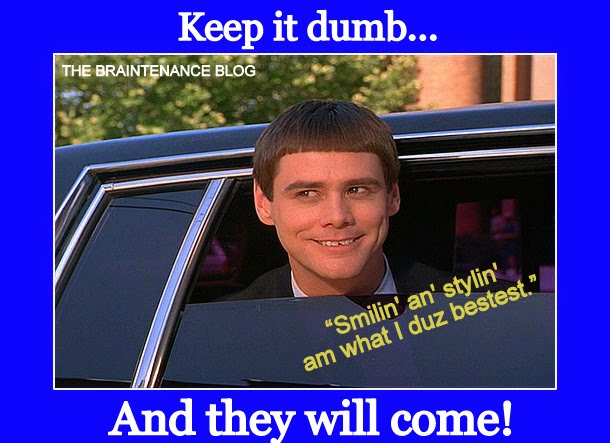
In the interest of Search Engine Optimization and attracting more "Mainstream Readers" from a growing population of abbreviators, texters, phonic spellers, urbanizers, ("Yo! U 'Aight?") hashtag huggers, semi-literate souls, libertine Lingovators, and other denizens of the world's 'audience', bloggers and other writers have had to increasingly limit their formerly extensive vocabularies to reach a steadily declining "lowest common denominator" of practical literacy.

Simplified, this means that if I want to get more hits (and more unique visitors) on my website or blog, I must state my message in terms that are getting simpler and simpler. I must lower my vocabulary skills and writing style to conform to that of the general public.

For example, if I've interviewed a person and want to mention something that he had said, I would not write "The Senator indicated..." I would write "He admitted..." --- not only have I participated in Operation Dumb Down, but I have deliberately added a sensationalizing twist to my word choice. Instead of reporting, I am inferring, accusing, or revealing fresh, secret information. After all, as one in a gazillion authors [gazillion? That's from Forrest Gump], I must be extra persuasive, extra seductive and simple enough in my message that people conducting searches with the simplest terms will be able to find my article.

It hurts not to use words like "atavistic" and "peccadillo," but then I must further my ranking and readership by littering my articles with anchor text and key terms that absolutely interfere with my writing style.

Where we are: We can no longer write as well as we speak.

Where we are headed: The next generation will not be able to speak (to articulate, to express, to verbally emote, to persuade, to argue, to use metaphors) as well as we speak now. There will be no one to teach them.

What to do about this: If you are a Braintenance Bulwark, and a faithful, fanatical follower of the occasionally alliterative Braintenance Blog you must:

1) Upgrade the caliber and character of your speech (you'll help keep the language alive and sound smarter than the petty politics player in the office next to yours who is hoping to get the promotion that you want by sucking up without substance). Experiment with new words culled from the dictionary and thesaurus online;

2) When you write for the public, pull them in with a nice paragraph laden with moronic search terms, anchor text clusters, and pop culture references, and then, when they are on your site, continue the article in your "real" style -- force some substance and allegory and other sophisticated crap down their throats so at least a small percentage of them will try to ascertain the nature of the comparison;

3) Read more about everything. Expand your envelope of relevance and familiarity with the terminology [specialized nomenclature] of other fields, hobbies and professions. Become more eclectic in your vocabulary and your ability to freely associate will increase.

Thank you, one and all. And. by the way, please take a look at The Twitterlinks Hubspot Blog to review at our giant repository [as opposed to our 'suppository,' which is stored elsewhere] of Twitter feeds on a wide variety of fascinating subjects. Please follow any that you'd like.

Douglas E. Castle

(Da dude what am da Prez dis page, keepin' it gangsta 4 U!)


View DOUGLAS E. CASTLE's profile on LinkedIn


Douglas E Castle
All Blogs & RSS Feeds

Share this page
Contact Douglas Castle
Follow Me on Pinterest

Monday, August 15, 2011

Figures Of Speech: Malaprops & Moronyms.

Share this ARTICLE with your colleagues on LinkedIn .


We bloggers (and the occasional speechwriter) use dictionary.com for quick word definitions, etymological stories (there's one below) and for alternate word choices. For this last, we use the Thesaurus feature. It ("Dic," as we chronic abbreviators and vulgar insinuators often call it... for short), is enormously useful, despite the fact that it is so laden with ads, pop-ups, pavilions, flash graphics and other distractions that the quick bit of information which you seek is often hidden ("obscured" would have been a snazzier word choice, but I'm in a rush) on the page.

While some people (mostly 23-year old internet billionaires or Baby-Boomers taking a break from looking for an employment opportunity which they'll never find) think this "word search" or "improve your visual acuity"- type exercise is fun, I detest it, although I wouldn't put that in writing. Being the Baron Of Braintenance (my hobby) as well as the modest Chairman of TNNWC Management Consulting Services (an adult job), I must keep all of my options and resources open. Flexibility and adaptation are crucial business skills.

Today, I needed an alternative for the word malapropism, and stumbled upon Mondegreen, which is defined and discussed below, courtesy of Dic. When children learn things by being encouraged to parrot what they are hearing from adults, they become mondegreen-manufacturers. For example, I remember singing "My country tis a bee, sweet lamb of liver tea, of thee I see..." And I wasn't the only one. It was a pandemic.

This mondegreenation (not exactly a Lingovation, but a grammatical extrapolation) is a product of a) not listening too closely, and b) not understanding the meanings of the actual words. Acquired early, these survive late into adulthood and can be the cause of embarrassment.

As children, we were afraid to run out in the cold for fear of catching "ammonia" and going into a "comber."

I once dated a woman (in her 40s at the time) who asked me if I had "...ever seen the Three Stoogers as a child." I knew that she had intended to say "stooges," but the damage was already done. I responded (smart aleck that I was) by saying "Yes. That was the best way to see them." She looked perplexed, but grinned sweetly. I knew that my overnight bag was going to stay in the trunk of my car.

Collectively speaking, I like to refer to all of these errors in spoken communications as "Moronyms." Whether they are spoonerisms, malaprops, grammatical extrapolations [I invented that] or just dumb things like "Notary Republic," the term moronyms (a legitimate lingovation, and cleverly engineered to look like such real words as homonyms, and synonyms) covers the field.

Enjoy your mondegreens, my cognition-craving, brain-straining colleagues. And be certain to visit these other pleasure stations within the TNNWC InfoSphere for stimulation: http://aboutDouglasCastle.blogspot.com, http://TakingCommand.blogspot.com, http://SendingSignals.blogspot.com, and http://Links4LifeAlerts.com.

mon·de·green

[mon-di-green] Show IPA
noun
a word or phrase resulting from a misinterpretation of a word or phrase that has been heard.


Compare eggcorn.
See also malapropism.


Origin:
1954; coined by Sylvia Wright, U.S. writer, from the line laid him on the green,  interpreted as Lady Mondegreen,  in a Scottish ballad.
Enhanced by Zemanta

Friday, October 8, 2010

Braintenance: Disinterest Rates

Share this ARTICLE with your colleagues on LinkedIn .


Situation Report @ 10.08.2010 - In the United States, interest rates throughout the economy (from the rate at which banks borrow from the Federal Reserve all the way down to the average home mortage rate). How low will they go? And for how long? Are they as low as the seemingly low rate of inflation? What does this all mean, Stimpy?


Braintenance: Di$interest Rate$

Dear Fellow Multicellular Organisms (and those Unicellulars who are thinking big):

This interest rate situation has me flummoxed. It begs several questions:

1. If interest rates are very low (but credit risks in the economy remain quite uncertain), what would be a bank's incentive to make loans to consumers and businesses?

2. If interest rates are very low (i.e., the neighborhood bank is offering an annual CD bearing a rate of interest lower than 1%), what would be a consumer's incentive to put any money into savings and bank instruments?

Would some citizen guru of economics please answer these questions for me? For some reason (call me "OCD"), I think that they are somehow important in the grand scheme of things, and for future planning and policymaking.

Also, I realize (but far too late) that I should have titled this article "Braintenance: Uninterest Rates." Does anyone appreciate the difference? [Hint: A disinterested party might possibly give me an answer, but an uninterested party would not.]


By the way, here's an example of a case (actually a very brief story) where an apparent bargain might not be a real bargain:

Let's say that a real estate broker comes knocking on your door and, gesticulating wildly and foaming slightly at the mouth, shouts, "Bobby! Bobby! (this is especially good if your name happens to be Bobby) There's a house in the best part of town that was sold to a guy ten years ago for a million bucks, and now it's for sale at a hundred thou! It's a steal!

Bobby nods his head and says, "Jeepers! That sounds great. If only I hadn't lost my job, lost my pension, run through my savings and had my house due to be sold at public auction tomorrow, I'd buy it. Oh heck. Darn my streak of bad luck."

That's about all there is to say about that. See you soon.

Faithfully,

Douglas Castle


Douglas Castle
Toll-Free Telephone: 888.317.6498
Facsimile: 914.517.5944
Become a Member Of TNNWC Group: http://bit.ly/JoinTNNWC

Bookmark and Share