Showing posts with label Social Sciences. Show all posts

Friday, July 12, 2013

The Three Secrets: Learning Language

Share this ARTICLE with your colleagues on LinkedIn .


There are three basic keys ('secrets,' if you wish) to learning to speak any language adequately (for most purposes) within an incredibly short period of time, with credit given, in part, to Dr. Pimsleur of the famous "Pimsleur Approach":

1) Every language has its principal structure in common with every other language. These common roots emerged from the very beginnings of Humankind's first use of language, and they have not changed structurally. Were you to waste some time a diagram a sentence in any language, you would find the same building blocks. While writing is different, speech is very much the same. Your mind is built to learn and speak any and all language;

2) Repetition, drill and writing actually inhibit our ability to "absorb" speech and to connect it with the core language center of our brains. These things don't enhance our ability, but they serve to confuse us and to set our subconscious minds on a destructive course to defeat our innate abilities [not to mention that they serve to bring back the years of accumulated self-doubts and limiting beliefs which keep us from being successful at most every endeavor. The harder you try, the more elusive the basics become;

3) We learn to speak a language better when we listen to it being spoken and begin to unconsciously allow our central 'language learning zone' to zero in on it. We learn to respond, hesitantly at first, and then faster and faster until we've reached a conversational pace.

Please enjoy the sales presentation by Pimsleur Associates which follows to learn a bit more. Please bear in mind that neither The Braintenance Blog, nor Douglas E. Castle, nor any of the affiliates of either have any financial interest in the Pimsleur Company or receive any compensation from the company; nor do any of the aforementioned persons or entities endorse or pass on the merits of the particular program.

Enjoy the presentation which follows, both for the wonderfully "open" and educational marketing approach, and for what is said[ enjoy the part about the 'phonological loop' of the brain -- that's entertaining and educational.

https://www.pimsleurapproach.com/presentation413.asp?sid=sl36004bnr&uid=454975&es=90

If for any reason the above link should fail you, try this one:

http://tinyurl.com/opa54ft

Thank you, as always for reading me and for sharing my articles with your connections, contacts and colleagues through your social media sharing tools and networks.

Douglas E. Castle

More about the Phonological Loop, from Wikipedia, slightly corrupt (ask BP!), but still useful:

The phonological loop (or "articulatory loop") as a whole deals with sound or phonological information. It consists of two parts: a short-term phonological store with auditory memory traces that are subject to rapid decay and an articulatory rehearsal component (sometimes called the articulatory loop) that can revive the memory traces.
Any auditory verbal information is assumed to enter automatically into the phonological store. Visually presented language can be transformed into phonological code by silent articulation and thereby be encoded into the phonological store. This transformation is facilitated by the articulatory control process. The phonological store acts as an "inner ear", remembering speech sounds in their temporal order, whilst the articulatory process acts as an "inner voice" and repeats the series of words (or other speech elements) on a loop to prevent them from decaying. The phonological loop may play a key role in the acquisition of vocabulary, particularly in the early childhood years.[3] It may also be vital for learning a second language.

Five main findings provide evidence for the phonological loop:
  1. The effect of phonological similarity:
    Lists of words that sound similar are more difficult to remember than words that sound different. Semantic similarity (similarity of meaning) has comparatively little effect, supporting the assumption that verbal information is coded largely phonologically in working memory.[4]
  2. The effect of articulatory suppression:
    Memory for verbal material is impaired when people are asked to say something irrelevant aloud. This is assumed to block the articulatory rehearsal process, thereby leaving memory traces in the phonological loop to decay.[5]
  3. Transfer of information between codes:
    With visually presented items, adults usually name and sub-vocally rehearse them, so the information is transferred from a visual to an auditory code. Articulatory suppression prevents this transfer, and in that case the above mentioned effect of phonological similarity is erased for visually presented items.[6]
  4. Neuropsychological evidence:
    A defective phonological store explains the behavior of patients with a specific deficit in phonological short-term memory. Aphasic patients with dyspraxia are unable to set up the speech motor codes necessary for articulation, caused by a deficiency of the articulatory rehearsal process.[7]
  5. On the other hand, patients with dysarthria, whose speech problems are secondary, show a normal capacity for rehearsal. This suggests that it is the subvocal rehearsing that is crucial.[8]
---------------- 


View DOUGLAS E. CASTLE's profile on LinkedIn

Douglas E Castle
All Blogs & RSS Feeds

Share this page
Contact Douglas Castle
Follow Me on Pinterest


CFI, C.F.I., CrowdFunding Incubator,  crowdfunding, crowd funding, incubators, accelerators, finance projects, listing services, start up, small business, SME, funding, capitalization, financing, leverage, company services, management, marketing, fundraising, technology, mentoring, advice, media, branding, memes, business tips tricks tools and resources, entrepreneur, forum, discussion, applications, technologies, risk assessment, business model, strategic planning, organizational development, connections, networking, early-stage, first-round, angel  funding, venture capital, credit lines, assistance, business growth, biz builders, social media power, delegation, automation, monitoring, metrics, brainstorming, meetups, joint ventures, partnerships - http://CFICrowdFundingIncubator.blogspot.com, http://www.CrowdFundingIncubator.com, marketing, messaging, news releases, free, gain market share, increase backlinks, SEO, influence, disruption theory, directory, RSS feeds, Douglas E. Castle, blogroll, blogs, crowdfunding blogs...


***
View DOUGLAS E. CASTLE's profile on LinkedIn

Douglas E. Castle - Blogger Profile
CFI - Notes From The CEO
Instant Musical Counterpoint - Relax!


Scoop.it

Saturday, February 2, 2013

Perception Exercises: Arouse Creativity - Expand Imagination

Share this ARTICLE with your colleagues on LinkedIn .


FIGURE A


FIGURE B


Perception exercises (those tasks where you must visualize a complex or elaborate scenario "in your head" absolutely arouse and stimulate your creativity and extend and expand expand your imagination. They involve using multiple parts of your brain located in both hemispheres, and often require that you actually close you eyes and either assemble objects, rotate or reposition objects, or visualize a scenario comprise of certain elements. You are literally exercising your imagination; and when you exercise your imagination, you give your brain the equivalent of progressive resistance exercise (the training a bodybuilder or power weightlifter uses for his or body), which strengthens it in every way.

Some pundits (or where they gurus?) have speculated that these exercises help increase coordination and communication between all of the different functional parts of your brain.

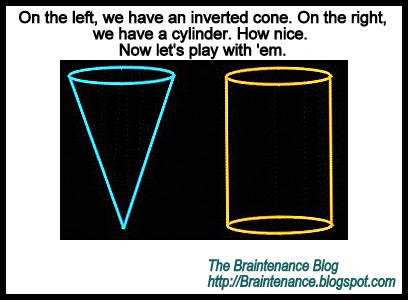
Brothers and sisters of The Braintenance Blog, let's try a few of these now. Before we do, take a look at the image at the top of this page, and study the characteristics of each geometric solid, as well as the relationship, in terms of differences and similarities between the two.

Here are a few questions to answer using the power of your ability to retain images and to assemble or reorient them in your mind's eye:

1) Which of the two figures is more stable, standing on its widest surface (on either end -- you choose)?

2) How many cones could you fit (with the dimensions in Figure B) could you insert into a cylinder (using the same dimensions as in Figure B)?

3) If you roll a cylinder across a table top, what type of shape would it create?

4) If you push a cylinder (by its wide side) on a table top, what kind of a shape would it create?

5) If you could glue a limitless number of same-sized cones together at their respective tips, what type of geometric solid would this fusion resemble from the outside?

6) If you knocked both a cone and a cylinder over, which of the two shapes is more likely to stay closer to you (instead of rolling under the couch where the dog might accidentally eat it?)?

7) Assume that the widest end (or at least one end) of  each of the shapes were open, which could you stack that would require less space?

8) If both shapes were filled with Styrofoam (or even vermiculite... choose any filling that you wish, as if you were at Aunt B's Yogurt And Cupcake shop) which one would float on its side, and which one would bob?

9) Why do you think that cones are used for automobile steering system precision testing, while cones are selected to be filled with sand to buttress certain highways (near toll booths and such) in the event of a car crashing into them?

10) Bonus! You get to reduce three dimensions to two! Position both shapes to be standing upright, and side-by-side. Cut each in half with a laser beam (or a sword, if you'd like). Without touching the bottoms, throw the tops away. Looking at each of the halved shapes at eye-level, which one will look like a rectangle, and which will look like a trapezoid?

And now, relax and enjoy a 20-minute audio track of nature sounds which is packed with life-affirming, positive suggestions. The brainwave entrainment pattern which is synchronized with the sounds is Beta, Alpha, Theta, Delta and back to Beta. Just click on the link below to enjoy it!

Sounds Of Nature + Positive Subliminal Suggestions, or if that seems to friendly, you can alternatively click on:

http://www.mediafire.com/download.php?d6w6w2qang3gxrn

As always, thank you for reading me and for sharing my articles with your social media.

Douglas E. Castle


View DOUGLAS E. CASTLE's profile on LinkedIn

Douglas E Castle
All Blogs & RSS Feeds

Share this page
Contact Douglas Castle
Follow Me on Pinterest


CFI, C.F.I., CrowdFunding Incubator,  crowdfunding, crowd funding, incubators, accelerators, finance projects, listing services, start up, small business, SME, funding, capitalization, financing, leverage, company services, management, marketing, fundraising, technology, mentoring, advice, media, branding, memes, business tips tricks tools and resources, entrepreneur, forum, discussion, applications, technologies, risk assessment, business model, strategic planning, organizational development, connections, networking, early-stage, first-round, angel  funding, venture capital, credit lines, assistance, business growth, biz builders, social media power, delegation, automation, monitoring, metrics, brainstorming, meetups, joint ventures, partnerships - http://CFICrowdFundingIncubator.blogspot.com, http://www.CrowdFundingIncubator.com, marketing, messaging, news releases, free, gain market share, increase backlinks, SEO, influence, disruption theory, directory, RSS feeds, Douglas E. Castle, blogroll, blogs, crowdfunding blogs...


***
View DOUGLAS E. CASTLE's profile on LinkedIn

Douglas E. Castle - Blogger Profile
CFI - Notes From The CEO
Instant Musical Counterpoint - Relax!

Wednesday, October 31, 2012

Raise Your IQ: View Art.

Share this ARTICLE with your colleagues on LinkedIn .


On a serious note, dear fans of The Braintenance Blog, observing art -- truly taking the time to examine paintings and other still visual forms of artistic creation -- can and does increase your IQ, as that is conventionally measured.

In the seemingly passive act of observing, we actually call into play numerous elements of spacial reasoning, cause and effect logic (and a search for meaning), identification of multiple symbols, spontaneous re-interpretations of the subject matter on the canvas (or other medium) at which we're looking, eye-mind area stimulation and neuronal connectivity... and numerous others.

It is quite ironic that in the simple act of viewing a painting, so many active excitations of both hemispheres of the brain (working in communication and a kind of cooperative harmony) are taking place.

For more on this topic, please have a look at my other blog, The Daily Dose Of Brilliance, and read the article which follows...then, click on the back arrow and come back to visit with us a bit more. I assure you that you will be captivated by the work of art on display there on my blog's cyberspace wall. You'll react.
---------------

Did you know that you can increase your IQ and creative ability just by looking at a work of art? http://bit.ly/IQview

---------------
Numerous studies in Europe, while not thoroughly conclusive, have scientists believing that viewing art can also have the following salubrious advantages:
Q: If we generalize and extrapolate this principle of passive psychoactivation visually, might it be possible that certain of our abilities may be enhanced merely by the seemingly passive act of listening to different types of music? I wonder...

Thank you, as always, for reading me... and for stretching your mind a bit further every time that we're together.

Douglas E. Castle


View DOUGLAS E. CASTLE's profile on LinkedIn

Douglas E Castle
All Blogs & RSS Feeds

Share this page
Contact Douglas Castle
Follow Me on Pinterest


Bookmark and Share