Showing posts with label probability. Show all posts

Thursday, August 23, 2012

Probability And Uncertainty / Chaos And Complexity - Temporal And Perceptual Field Insufficiencies.

Share this ARTICLE with your colleagues on LinkedIn .


As some of the more advanced members of our growing Braintenance crowd might have guessed based upon enhanced telepathic powers (or by having read the title), this is indeed a post on probability and uncertainty, and on chaos and complexity. All of these are nouns representing ideas or theories based upon observed behaviors, and upon the inherent limitations of observations.

Probability is the likelihood of a given outcome based upon observed experience over an expanse of time. We know that the likelihood or probability of a coin landing with the 'heads' side up is .50 or 50%. And we also know that each toss of a coin is an independent event. Despite this statistical logic, if we toss ten coins and they all turn up 'heads' -- we start to develop an "experiential probability bias," and we start to think (despite ourselves, and despite what we know to be the truth) that the next coin toss is more than 50% likely to result in a 'tails' outcome. We tend to think that way because we forget that probabilities are based upon averages over time, and we start to think that if one result is prevalent for a longer period than expected, there is a "cosmic force" of some sort that must make the ratios fall into line.

But again, probability is based upon observation of a given even over a significant period of time [whatever "significant" means].

Uncertainty is a different situation. Where we haven't observed a certain event enough times to determine a pattern of likelihood, we tend to be uncertain. Some of us will even attribute an arbitrary (but customary) 50/50 probability to an event where we don not have empirical evidence to support a probability pattern.

But what if those patterns are actually there -- but their periodicity is, say, longer than a lifetime. We frequently fail then to observe the probability pattern. If the scope of our observation of an even is limited, we deal in uncertainty and fail at predictability. Geologists and certain other scientist dealing with certain phenomena which take place over great lengths of time are becoming better at seeing patterns and periodicity in certain major events, and are becoming better predictors of the future based upon a greater gathering of experience based upon a longer perspective of history.

My favorite Braintenance analogy is the confusion between chaos and complexity.

Events that we may see or consider as chaotic, or random, may in fact be part of a very grand design which takes place beyond the ordinary scope of our perception (we are limited there), or beyond the period of time required to recognize the occurrence as a pattern. Perhaps we haven't lived long enough to see a recurrence of the seemingly isolated event -- for example, perhaps we have only lived long enough to see the passing through the heavens of Hally's Comet; a change in the Earth's magnetic polarity; a massive climatic change - yet, scientists do not only tell us that these events have occurred more than once before... in some cases they can tell us when they are anticipated to occur next.

In the above case, the relative shortness of our lives does not permit us to see the recurrence of the event and conclude that it is either a pattern or a part of a far greater and more complex series of cause and effect events which contain the pattern. I call our failure to recognize many such patterns as being due to a Human Temporal Insufficiency.

These greater wave-like patterns are either much longer in duration (i.e., they occur over a long period of time and are gradual and continuous enough that we cannot perceive of the change) or they occur at intervals to great for us to readily measure using our senses. Temporal insufficiency can handicap our view of the world, and it usually does. Economic and political cycles are much more recognizable as patterns because their "wavelength" is much shorter than the intervals between, say ice ages.

Other patterns which do not seem like patterns to us from our ordinarily visual perspective, are just too large in size for us to see unless seen from a much higher and greater vantage point. Some examples include many of the greatest wonders of the world (such super-sculptures as the pyramids, long 'runways', and the ever-popular crop circles) as well as astrological patterns and symbols which are not recognizable as such from the hiker's view, but which become very clear when seen from the air.

I refer to our inability to perceive these as non-chaotic and reasonable as Perceptual Field Insufficiency.

Together, our Temporal Insufficiency combined with our Perceptual Field Insufficiency make probabilistically determinable things seem like random events (uncertainty instead of probability), and make very large, potentially meaningful things (as patterns recognizable only from a 30,000 foot view) seem chaotic or discrete, and not a part of something greater.

I would suggest you read this brief article several times over, put your imagination to work [don't confine it to its usual inviolate parameters], and start to enjoy a new view of a far greater, vaster, more meaning-filled universe.

Douglas E. Castle for The Braintenance Blog and for The Daily Burst Of Brilliance Blog


View DOUGLAS E. CASTLE's profile on LinkedIn


Douglas E Castle
All Blogs & RSS Feeds

Share this page
Contact Douglas Castle
Follow Me on Pinterest

Monday, July 16, 2012

Randomness And Probability: Different Things? [Chaos And Complexity]

Share this ARTICLE with your colleagues on LinkedIn .


As some of the more advanced members of our growing Braintenance crowd might have guessed based upon enhanced telepathic powers (or by having read the title), this is indeed a post on probability and uncertainty, and on chaos and complexity. All of these are nouns representing ideas or theories based upon observed behaviors, and upon the inherent limitations of observations.


When we speak of randomness and probability we generally mean two different things. Essentially, probability is the mathematically determined likelihood (expressed as a decimal, a fraction, a percentage or odds) that an event or an outcome will occur, given parameters.

For example, when we toss a coin, the odds are (stop yawning!) 50% that it will land on heads and 50% that it will land on tails. This probability is based upon repeated trials over time. There are two standards -- 1) repeated trials (doing the exercise and observing the result as many times as possible to gain more certainty as to the probability of a given outcome -- this is based upon the belief that history tends to repeat itself), and 2) over time -- which means that the same experiment or test has been run numerous times, and the result has not changed over time.

Probability is something that is not the equivalent of certainty, but it gives us the likelihood of a certain outcome based upon specified parameters, numerous trials and consistency over time.

When people speak of randomness, they tend to equate it with immeasurability and a complete inability to predict outcomes. Randomness is, however, quite possibly a perceptual term, based upon subjective error, rather than an objective and defining one.


Randomness may be a perceptual error. In fact, randomness, on a macroscopic scale and over a longer time frame may exhibit the patterns of predictability (waves, cycles, percentages) associated with probability. What appears to be chaotic from a limited perspective, may actually be a complex process which has not yet been parametrized or calculated, like the toss of a coin, or the selection of colored marbles from a jar.

Here's the key -- if any event or phenomenon is observed over a long enough period of time and from an adequate distance to incorporate a grander view, that event may prove to be predictable (in terms of cause and effect) and calculable (in terms of probability).

The more that we study complex systems and chains of seemingly unrelated events, the more it appears that they may actually be wave-based, recursive (as are fractals) and predictable within a reasonable margin of error, as are all events or phenomena to which probabilities have been assigned.

Our limited vision and shallow perception might cause us to see tiny, seemingly random parts of a more complex system or chain of events with correlation and causality.

As a last thought: Perhaps there is no randomness, and there is only reason.


Think about it. Expanded perception might give us a look at the entire knitted quilt instead of just one seemingly isolated square...


Douglas E. Castle for The Braintenance Blog


@DouglasECastle1 @Braintenance #Braintenance #IQ #altered states of perception


To find a wonderful list of varied, interesting Twitter feeds to follow, please come and visit us at The Twitterlinks Hubspot Blog. Thank you, one and all.


View DOUGLAS E. CASTLE's profile on LinkedIn


Douglas E Castle
All Blogs & RSS Feeds

Share this page
Contact Douglas Castle
Follow Me on Pinterest

Tuesday, September 21, 2010

Brain-Twister: Tossing A Coin - Not So Simple...

Share this ARTICLE with your colleagues on LinkedIn .


Brain-Twister: Tossing A Coin - Not So Simple...

Dear Friends:

Note: This article is secretly a post about Management, and how people think. But I won't tell you that. You see, people take Management very seriously, and they shut down at the mere sight or sound of the term. But if we re-frame the same content as a Brain-Twister, everybody wants to play! Don't speak a word of this to anyone!

When I was a mere tadpole in the New York System (which system has subsequently become a tragic) study in entropy, I was taught about probability. We were all indocrinated about the difference between "independent events" and "dependent events."

Every one of us was absolutely clear that each toss of a "fair coin" (balanced, and not weighted or otherwise structurally altered) was an independent event, with the probability of the coin's landing on Heads being equal to .50 (fifty percent) and the probability of the coin's landing on Tails also being equal to .50 (fifty percent). Each coin toss was independent of any other coin toss, and the probability of a tossed coin landing with the heads side up was exactly the same as was the probability of the same tossed coin landing with the tails side up.

It was an immutable, irrefutable proposition.

What they never told us was that these probabilities were "statistically determined" based upon a "very large" number of tosses. As we all know, occasionally you can toss a coin several times and get just heads, just tails, or some combination that was not quite 50/50. Intuitively, we believed that given enough tosses, the number of times that heads would come up would always be equal to number of times that tails would come up. The notion of an infinite number of tosses tending toward the sacred 50/50 ratio was never questioned -- yet, when tossing a coin just a few times, the outcome was, in fact, very seldom, 50/50.

Here's my question, framed in several different ways:

If you were betting on a coin toss game (which was unfixed, honest and legal), and the first two tosses turned out to be heads, would you bet on heads for the next toss? How about if the first four tosses turned out to be heads? How about if the first seven tosses turned out to be heads (statistically unlikely, but definitely possible)?

Here's my observation:

As the number of heads in a row increased, the odds of your betting on the next toss coming up heads would be reduced. In your mind, you are probably thinking something like this..."Since the statistic is eventually supposed to average out to 50/50 the REAL LIFE odds of the next toss resulting in landing on heads is decreasing with every toss. The next one's JUST GOTTA turn up to be tails."

What is the reason for this type of thinking? It is because we feel that the individual tosses are not truly independent, and that the earlier tosses are "statistically forcing" the outcome of the next toss.

If you had never been taught about this 50/50 statistical tendency (let's say that you were some cave-dwelling type of individual, as were many of my relatives, and that you only knew what you observed) -- you would then behave in just the opposite manner. With each toss resulting in heads, you would become increasingly convinced that the next toss would ALSO be heads. Your reasoning would be based purely upon your observation of a relatively small number of occurences.

Here's My Confession:

After seeing an increasing number of heads coming up in a row, I would become increasingly likely to bet on tails...as if the tosses had to support the statistic based upon the infinite example. I believe that somehow the universe will force the next toss to bring my observations into line with what I'd been taught. This means that I do not fully believe that each toss is truly independent of the next.

Here's Some Food For Thought:

Both the cave-dweller (my great-uncle Farkas) and I would be biased based upon either pre-conceived notions or inadequate testing. We would both be using logic, but we would both be wrong.

Here's a Bit More:

People make decisions either based upon over-education or under-experience.

As always, I welcome your comments.

Faithfully,

Douglas Castle

p.s. Please feel to express your thoughts regarding this post in the Comment Section which follows in the itty-bitty hyperlinks under this article.

Article Appears Courtesy Of http://Braintenance.blogspot.com


Douglas Castle
Toll-Free Telephone: 888.317.6498
Facsimile: 914.517.5944
Become a Member Of TNNWC Group: http://bit.ly/JoinTNNWC


Gratuitous Picture Of Albert Einstein:


LINGOVATIONS are featured in The BLUE TUESDAY Report Weekly. If you'd like to get your free subscription NOW, just go to http://www.tnnwcgroup.com/. To see the latest issue of The BLUE TUESDAY REPORT, go to http://www.thenationalnetworker.com/BlueTuesday.shtml.

Google LINGOVATIONS for more information!

Did you ever think that Google would become a verb?

Wednesday, May 12, 2010

Facts, Fiction and Exploitation - Things To Be Concerned About - Douglas Castle

Share this ARTICLE with your colleagues on LinkedIn .


Please Note: This Article was simultaneously published in The Global Futurist, The Internationalist Page, and The National Networker RSS and Daily Email Feed Blog. It has been reprinted in full, and appears here with permission. You may re-publish this article at no cost, and without seeking the author's permission provided that you 1) publish the article as it appears here, in its entirety, without editing, or deletion (re-formatting is permissible), and 2) leave all of the illustrations and hyperlinks live and intact. Thank you.

If you wish to join The National Networker Companies' GICBC, receive our publications and be granted access to our unparalleled Suite Of Services for Empowering Emerging Enterprises, Membership is free, and without obligation. Simply click on http://bit.ly/JoinTNNWC .
---------------
Facts, Fiction and Exploitation - Things To Be Concerned About - Douglas Castle
 
1). If Someone Wins All Of The Time At Any Game Of Chance, The Game May Be Rigged.
 
2). If Someone Claims To Win All Of The Time At Any Game Of Chance, They May Be Lying.
 
3). In The Securities Marketplace, A "Greater Fool" (Or Fools) Must Incur Losses for The Purported Winners to Keep Winning -- It is Rather Like A Game Of Musical Chairs...When The Music Stops, Someone No Longer Has A Seat, And Is Stuck With Overpriced And Unsaleable Investments.
 
4). Big Securities Trading Firms Have Credit -- If They Incur A Positional Loss For One Day, They Don't Have To "Settle Up" With The Bank Until They Have Had An Opportunity To Trade Some More, And Win Back Their Losses (Usually At Somone Else's Expense)... And What If These Large Firms Are Intimately Affiliated With Those Banks? [Conflict Of Interest? Hmmm...]
 
5). Smaller Investors In The Markets Do Not Have The Credit Facilities To Buy Time To "Set Things Right." They Must Pay For Their Losses Immediately, In the Worst Of Possible Circumstances And Lose Their Holdings In A "Fire Sale" Scenario. Then, They Can Never, Ever Recoup Their Losses. These Losses Become Permanent. Large Trading Firms And Their Bankers Get To Lock In A Profit Because Of Their Obvious Credit Advantage.
 
Observation A: The Large Banks ("too big to fail!"), The Trading Firms ("slap them on their greedy wrists!"), An Impotent And Often Compromised Government Are Aggressively, And Perhaps Maliciously [Conspiracy? No -- That's Silly Stuff] Bringing The Public To Its Knees.
 
Observation B: This Is Not Because Of Capitalism. This Is Because Of Encultured, Unpunished, Short-Sighted Greed.
 
Observation CIndividuals, Entrepreneurs, And Emerging Enterprises Must Act Expediently If They Are Not To Become Enslaved. Cooperation and Collaboration Can Be Used To Rapidly Unite And Grow These "Grassroots" Victims Into A Force With Lobbying Power, Resources And Political Clout.
 
The above ends my rant. The following article, which was published in The Daily Reckoning, caught my attention:
 
Goldman's Perfect Quarter
Defying the odds in the "robot combat arena"

Eric Fry
Eric Fry
Reporting from Laguna Beach, California...

While the European Central Bank (ECB) was busy manipulating markets and making headlines Monday, Goldman Sachs was quietly revealing a different story of market manipulation...or something that walks and quacks very much like a market manipulation duck.

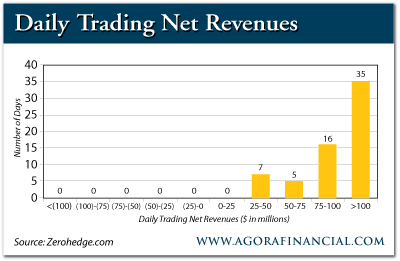
In an SEC filing, Goldman disclosed its first-ever "perfect" quarter. The firm's proprietary trading desk navigated the first quarter without producing a single day of losses, the first time it had accomplished such a feat.

How is this possible? Please permit us to offer a simple explanation: It's not.

Imagine a poker player who competes against skilled competitors for 63 sessions of 6 1/2 hours each, then walks away with a profit after all 63 sessions. Would that be possible? Not unless the poker player is holding a stack of aces up his sleeve. But Goldman accomplished this improbable feat. Its trading desk turned a profit on each and every day of the first quarter - that's 63 trading sessions of 6 1/2 hours each, not counting whatever additional shenanigans Goldman was conducting in foreign markets.

There is something wrong with this picture...very, very wrong. And yet, Goldman trumpets this success as an example of something that is very, very right. "This is the first time we have reported zero trading loss days in a quarter," crowed Samuel Robinson, a Goldman Sachs spokesman. "We believe it shows the strength of our customer franchise and risk management."

An alternative interpretation would attribute Goldman's uncanny trading success to the strength of its "political franchise," subsidized risk- taking and various forms of de facto front-running. If, as James Howard Kunstler asserts, the US stock market has become "a robot combat arena where algorithms battle for supremacy of the feedback loops," Goldman Sachs must control the "Supreme Combat Robot." But we wonder whether this robot is abiding by all applicable securities laws, or vaporizing them with his special "Mega-fraud laser beam."

"If you ever wanted to see what a monopoly looks like in chart form," jokes Tyler Durden from Zero Hedge, "here it is:


Daily Trading Net Revenues


"The firm did not record a loss of even $0.01 on even one day in the last quarter," Durden says. "The statistic probability of this event is itself statistically undefined. Goldman is now the market - or, in keeping with modern market reality, Goldman is the 'house,' it controls the casino, and always wins. Congratulations America: you now have far, far better odds in Las Vegas that you have making money with your E- Trade account."

In fairness to Goldman, JP Morgan also produced a perfect quarter of proprietary trading. Morgan Stanley, the relative loser in the crowd, managed to produce a trading profit on only 93% of its trading days.

"The rape and pillage of the middle class was not isolated to Goldman," Durden continues. "JP Morgan also had a flawless quarter. And if the odds of Goldman making 63 out of 63 are virtually impossible in any universe in which risk goes hand in hand with return (but in those in which monopolies are encouraged and bailed out), the coincidence of the two main firms that control the world having a perfect track record is impossible. And since things in reality tend to be zero sum, when everyone makes money, someone may be tempted to ask the question, just who is losing money? And the answer, dear taxpayers, and [Goldman/JPMorgan] clients, is you."

Perfection is either a religious virtue or a devilish fraud, dear reader; it is never a financial market reality. So there's something a little troubling about the perfection achieved by Goldman's (and Morgan's) trader-bots. In fact, there might be something a lot troubling about their trader-bots, as well as their investment-bank- atrons.

Perhaps the truth will come to light in the fullness of time...or in the details of a future SEC complaint.

Goldman acknowledged in Monday's SEC filing that it still faces a large and diverse number of criminal and quasi-criminal investigations. In addition to a bevy of investigations by the SEC, Goldman is facing detailed probes by the Justice Department, the Financial Industry Regulatory Authority and the UK's Financial Services Authority related to CDO offerings and related matters.

"We anticipate that additional putative shareholder derivative actions and other litigation may be filed, and regulatory and other investigations and actions [will be] commenced against us with respect to offering of CDOs," Goldman's filing somberly disclosed, "[These probes] could result in collateral consequences to us that may materially adversely affect the manner in which we conduct our businesses."

Hmmm...we'd guess that the list of "collateral consequences" would include reducing Goldman's trading success from 100% to something much lower. And since trading revenues accounted for 80% of Goldman's revenue in the first quarter, we'd guess that much lower net profit will be another "collateral consequence."
####

In my opinion, this article, while more than a bit sardonic in its tone, is dire in its implications.

Faithfully,

Douglas Castle

 
About Douglas Castle
Douglas Castle - LinkedIn Profile 
The National Networker Companies
Braintenance - Stay razor sharp.
The Internationalist Page - A world without barriers.
The Global Futurist - Revealing trends.
Taking Command! - Mastering your fate.
LINKS 4 LIFE - Crisis resources.
Follow Castle on Twitter 
Follow TNNWC on Twitter
Join Us: Become a Member of the TNNWC Global Interworked Cooperative Business Community (GICBC) at no cost. Click on http://bit.ly/TNNWC


Labels, Tags and Terms: probability, rigged games, falsehoods, conflicts of interest, the greed factor, taking versus earning, capitalism, Goldman Sachs, cooperation, collaboration, conglomeration.

Monday, March 29, 2010

Braintenance: Permutations and Combinations!

Share this ARTICLE with your colleagues on LinkedIn .


Dear Fellow Cranial Crunchers:

You now have some problems. Wait. Let me re-phrase that. It was politically incorrect. Perhaps, "You now have some issues." No... perhaps, "You must now address some challenges." Ah, much better.

1. In a group of ten individuals, how many pairings are possible?

2. In a group of ten individuals, how many combinations of 3 individuals each are possible?

3. In a group of ten individuals, how many combinations of 2 or 3 individuals are possible?

4. Five paintings are to be arranged in a row on a wall. How many different arrangements are possible?

5. Same facts as in question 4, above: How many different arrangements are possible where two paintings by one particular artist must be side by side?

Hop to it!

Faithfully,

Douglas Castle
--------------------------
For some helpful hints to assist you in finding the right answers for the above questions, you can get a free instructive download at:
http://www.mediafire.com/?ldfhznjmgmy


COMMENT On This Article!
Comments to Douglas Castle
About Douglas Castle 
Douglas Castle - LinkedIn Profile
The National Networker Companies
Braintenance - Stay razor sharp.
The Internationalist Page - A world without barriers.
The Global Futurist - Revealing trends.
Taking Command! - Mastering your fate.
Follow Castle on Twitter 
Follow TNNW on Twitter
Follow Braintenance on Twitter
*Subscribe (free!) for The National Networker Newsletter and the BLUE TUESDAY REPORT, and join The TNNWC GICBC at Join Us!

Friday, January 23, 2009

BRAINTENANCE QUIZ 1/23/09

Share this ARTICLE with your colleagues on LinkedIn .


Dear Friends:


Now that you have had the opportunity to enjoy a well-earned day's rest, let's switch the format of our meeting. I offer some solutions before I pose new problems. Variety is an intellectual stimulant (as it is a leading cause for divorce in the US...but then, that's in a different context). Please refer to the last two posts on this blog, as it's generally a good policy to know the questions tha the answers relate to!
-------

Question: What would the amount and the dilution be of hyroxyidiotic acid be in bottle #3 at the end of this process? This is a question that can be answered intuitively, without much math at all (phew). In Question #3, we were left with 1 gallon of 20% hydroxyidiotic acid in bottle #3. In Question #4, we added 1 gallon of 10% of hydroxyidiotic acid to bottle #3. In sum, bottle #3 now contains 1 gallon of 20% acid, and 1 gallon of 10% acid, or 2 gallons of 15% hydroxyidiotic acid. If we were to have done the math, we might have used this calculation: (.50) (.20) +(.50) (.10) = .15 , or 15%.
_________________________________________
How many 5-letter combinations can you make of the name OBAMA, where none of those combinations started with an "O"? The computation is simple (but with a twist): for the first letter slot you have 4 possible letters; for the second, 4; for the third, 3: for the fourth, 2; and for the fifth, 1 --- by multiplying 4x4x3x2x1, we get 96 arrangements of letters that do not begin with the letter "O". But what about the arrangements that are redundant because they have two "A"s in them....Hmmm....perhaps you need a bit more time.

Since every arrangement of these letters will contain two letter "A"s, and it doesn't matter which A is being used, half of our arrangements will be redundant. What we must then do is eliminate half of the arrangements in order to eliminate these redundancies. If we divide 96 in half, the result will be 48 arrangements, which is our answer.
______________________________________
Now for a second surprise...there is no problem for today. There is merely a wonderful exercise. Take at least 30 minutes at some time time today, and sample some of the audio/video clips below for mind expansion purposes. Scroll down to EXERCISE YOUR MIND 6: MEDITATION, STIMULATION AND RELAXATION. Enjoy the experience!

Faithfully,

Douglas Castle
INTERNAL ENERGY PLUS

Bookmark and Share