Showing posts with label Braintenance. Show all posts

Tuesday, November 3, 2015

Commitment+Control+Challenge=SUCCESS || Braintenance

Share this ARTICLE with your colleagues on LinkedIn .


While sifting through the vast quality of articles, newsletters and reports in my Braintenance Inbox, I came across  an interesting "News Release" written and distributed by PsychTests that truly resonated with me. It's about why some of us survive and actually thrive under the trials of adversity, while others crumble and become embittered to the point of immobility. Please read on...


Diagnosis: Attitude Problem – PsychTests’ Study Reveals How The Trait Of Resilience Affects Well-being
 
Research by PsychTests.com indicates that resilient people approach stress, challenge, and life in a way that boosts their well-being.
 
Montreal, Canada – November 3, 2015 – Attitude is everything. The Buddha wisely said that “The secret of health for both mind and body is not to mourn for the past, not to worry about the future, not to anticipate the future, but to live the present moment wisely and earnestly.”
 
So what makes some people so resilient in the face of seemingly insurmountable challenges? Research conducted at PsychTests using the Hardiness Test reveals that resilient people take a unique approach toward life that can be summed up in three words: Commitment, Control, and Challenge.
 
When people share stories that depict the indomitability of the human spirit – overcoming the physical and mental challenge of climbing Mount Everest, surviving in a war-torn country, conquering a potentially fatal illness – listeners and admirers can’t help but wonder two things: “Where did they get the strength to endure and fight?” and “If I were in their shoes, how could I have coped?”
 
Resilient, hardy, or mentally tough people view and approach their world in a unique way. A study conducted by the researchers at PsychTests reveals that these “tough cookies” do more than survive – they thrive. And the secret to their survival is a simple formula: Commit + Control + Challenge = Success.
 
Resilient individuals commit themselves to every activity they take on, no matter how trivial. They take responsibility for their actions and their life (i.e. they have an internal locus of control). Finally, they view a stressful situation as a challenge to overcome, rather than as a permanent setback or obstacle.
 
PsychTests’ research also reveals other information about how hardy people strive to thrive:
 
·        71% accept change when it is required (compared to 14% of people who are not hardy).
·        83% can find something enjoyable in even the most mundane tasks (compared to 2% of people who are not hardy).
·        98% are actively involved in hobbies or other leisure activities (compared to 50% of people who are not hardy).
·        91% believe that they are in full control of their destiny (compared to 26% of people who are not hardy).
·        93% look forward to their day (compared to 8% of people who are not hardy).
·        94% find ways to “spice up” everyday tasks (e.g. listening to music while cleaning; rewarding themselves after getting all the cleaning done, etc.), compared to 18% of people who are not hardy.
·        When they fail at something, 80% use it as motivation to try harder next time (compared to 5% of people who are not hardy).
·        In the last year, 18% of hardy people in the PsychTests’ study took more than 3 sick days last year. Of the people who are not hardy, 47% took more than 3 sick days.
·        58% of hardy people exercise 3 or more times per week, compared to 24% of people who are not hardy.
·        79% of hardy people eat a healthy diet, compared to 33% of people who are not hardy.
 
“Hardiness isn’t a trait you are born with. It’s built through trial, failure, determination, and perseverance,” explains Dr. Jerabek, president of PsychTests. “Resilient people still go through moments when they feel like giving up, or when they don’t see any possible solution to their problem – but they keep plodding on. They choose to believe that they will find a way out of the situation, and that things can and will get better. Most importantly, resilient people understand that the challenges they go through are not meant to break them but to make them stronger, wiser, and even more determined. And the only difference between hardy people and those who crumble under stress is not in their experiences, but rather how they interpret them. Resilience is a purely mental. Your ability to overcome a problem, setback, stressor, or challenge depends entirely on how you view it.”
 
PsychTests offers some tips to boost hardiness:
 
·        Take pleasure in the small victories. Even the hardest occupations have moments when you can stop and savor a job well done, a person helped, or a difficult task accomplished. By stopping for a moment to reflect on your accomplishment, you can begin to feel less overwhelmed and more satisfied with the work that you are doing.
 
·        Accept that you’re going to have bad days. Even people who are naturally positive, upbeat, and love what they are doing in life have a day where it seems like everything that could possibly go wrong does go awry. However, those bad days here and there don't stop them from appreciating the overall positives in their lives. If you tend to become pessimistic after a bad stretch, fight against the tendency by reminding yourself of the good things. And if a situation or issue is really becoming a thorn in your side, try taking the long view. Think about how you will feel about the situation in ten years. Either you will think nothing of it, or you will regret not doing anything. Regardless, you will gain motivation to move on with your life, either working to overcome the setback or to move on.
 
·        Take a step back when a challenge overwhelms you. Getting out of the situation for just a little bit will help you relax and put things in perspective. Try breathing techniques, meditation, or simply changing to a different task to get your mind off of the difficult undertaking. Sometimes, when a molehill looks like a mountain all it takes to regain perspective is to talk it over with a friend who can offer objective insight and help you outline steps for the future.
 
·        Know the benefits of having an internal locus of control. Although taking responsibility for your actions may sometimes cause you to feel disappointed in yourself (e.g. accepting blame for a failure), it also leads to greater self-motivation and a more active attitude towards life. People who feel that they have control over the outcome of their actions are more likely to take ownership of their behavior and exert a concentrated effort to learn, improve, and grow.
 
·        Eliminate "cognitive shortcuts.” These are automatic, habitual, deeply-ingrained and self-defeating ways of thinking, and often consist of some variation of the following: “I’ll never be able to do this because I’m too old/poor/weak/scared/uneducated/ugly/fat etc. These negative thoughts are surefire success-killers because they lead to self-fulfilling prophecies. Stop these shortcuts in their tracks. Dig deeper to determine why you feel this way about yourself. Is this something you were told growing up? Do you have proof that this thought is true? Are there examples of moments in your life when this was NOT true? What would be a better, healthier way of viewing this situation – and yourself?
 
Want to assess your level of hardiness? Go to http://testyourself.psychtests.com/testid/2099
 
Professional users of this assessment (therapists, life coaches and counselors) can request a free demo of this or any other tests from ARCH Profile’s extensive battery: http://hrtests.archprofile.com/testdrive_gen_1 
 
To learn more about psychological testing, download this free eBook: http://hrtests.archprofile.com/personality-tests-in-hr
 
 ###

Thank you, as always, for reading me. I hope that you enjoyed the News Release reproduced above!

Douglas E. Castle


Please Join Me On LinkedIn

Please Follow GEI Consulting On LinkedIn

Please Like GEI Consulting On Our Facebook Page

Please Follow GEI Consulting On Google Plus


Respond To Douglas E Castle
http://bit.ly/CASTLEDIRECT

BRAIN TEASERS,
BRAIN BOOSTERS &
COGNITIVE ENHANCEMENT!


FUNDING BUTTON LINK

BRAINTENANCE: Train, Strain And Improve Your Brain. Expand Your Mind.

http://braintenance.blogspot.com

Braintenance contains articles, resources, exercises, games and specially-designed protocols to improve the power of your brain and your mind in every significant aspect, including memory, cognition, IQ, plasticity, creativity and problem-solving ability.

Key Terms: brain, mind, cognitive enhancement, memory, brain gym exercises, IQ, plasticity, mind expansion, creativity, meditation, altered states, perception, self-hypnosis, self-growth, neuron, artificial intelligence, learning, somatic intellect, mathematics, language, dissonance, individualism, herd mentality, puns and word games, linguistics, genius, emotion, subconscious, unconscious, intuition, instinct, psychedelic, reality, learning curve, probability, collective consciousness


***************
This site is proudly affiliated with Global Edge International Consulting Associates, Inc. ["GEI”]
Free Subscription to The GEI Business Daily!
Sign Up For Our Free GEI Newsletter!
Receive Our Free GEI RSS Feed!

***Follow GEI's Company Page On LinkedIn!

Please Like GEI on Facebook...

Like GEI On Facebook


Please Follow GEI on LinkedIn...
Visit Our Linked In Company Page

Please Follow GEI on Twitter...
Follow Us On Twitter

Sunday, September 6, 2015

Brainwave Entrainment For Mind Mastery - Braintenance - Douglas E. Castle

Share this ARTICLE with your colleagues on LinkedIn .


Brainwave Entrainment For Mind Mastery
External Audio And Visual Stimuli Can Change Brainwaves, Brain Chemistry And Your Thinking


Brainwave entrainment is any practice that aims to cause brainwave frequencies to either mimic or to fall into step with a periodic stimulus having a frequency corresponding to the intended brain-state (for example, to induce sleep or to induce focus), usually attempted with the use of specialized light and sound effects. It depends upon a "frequency following" response based upon the assumption that the human brain has a tendency to change its dominant EEG frequency toward the frequency of a dominant external stimulus. Entrainment is not to be confused with subliminal programming where thought patterns are subconsciously or superconsciously receiving actual audio or visual messages to induce behavioral or mood changes.
For Entrainment, stimulus may be audio, as in the case of binaural or monaural beats and isochronic tones, visual, as with the use of a dreamachine (an item of specialized equipment), a combination of both audio and visual with a mind machine, or with electromagnetic radiation. We will only be dealing with audio and visual stimuli for the purposes of our Braintenance regimen.
Hemispheric synchronization, a desired result of some forms of brainwave entrainment, refers to a mind state where the brainwave pattern of the right and left hemispheres become alike, or synchronized – in harmony together. A person with similar activity in both hemispheres is prone to be happier, more optimistic, more emotionally stable and less prone to mental illness, although this last claim is purely anecdotal without much hard evidence to support it. Increased levels of synchronization can be found naturally in people who meditate regularly and in people who are very content with their lives.
We've selected several brain entrainment videos (with accompanying audio tracks) to induce different brain states. Remember: Life is an experiment and the world is your laboratory. In the case of these entrainment tracks, it is helpful (but not crucial) to have stereophonic headphones patched into your computer, and to watch the videos on a full screen setting. These will generally work best on devices with larger screens. Turn the volume up loudly so as to be consumed by it, and so that it will block out incidental ambient noise.
The selected tracks are hyperlinked below. The best time to try them is in the early evening after you've finished your day's work and you can relax and focus, uninterrupted, without time constraints. Some of these tracks are fairly long so be prepared to sit still and dedicate some time to each. Do not drive or operate equipment or machinery soon after enjoying any of these tracks – some of them will make you feel drowsy or trippy. Try a different track on each night of the week. If you find one or more to be particularly helpful or just enjoyable, repeat the experience as often as you would like.

Here are the tracks:

https://www.youtube.com/watch?v=J73kveWTj68
https://www.youtube.com/watch?v=1zhjcMBDivI
https://www.youtube.com/watch?v=KNuoGeD9Qeo


Thank you, as always for reading me.
Douglas E. Castle for The Braintenance Blog and GEIconsulting
Please Join Me On LinkedIn

Please Follow GEI Consulting On LinkedIn

Please Like GEI Consulting On Our Facebook Page

Please Follow GEI Consulting On Google Plus


Respond To Douglas E Castle
http://bit.ly/CASTLEDIRECT

BRAIN TEASERS,
BRAIN BOOSTERS &
COGNITIVE ENHANCEMENT!


FUNDING BUTTON LINK

BRAINTENANCE: Train, Strain And Improve Your Brain. Expand Your Mind.

http://braintenance.blogspot.com

Braintenance contains articles, resources, exercises, games and specially-designed protocols to improve the power of your brain and your mind in every significant aspect, including memory, cognition, IQ, plasticity, creativity and problem-solving ability.

Key Terms: brain, mind, cognitive enhancement, memory, brain gym exercises, IQ, plasticity, mind expansion, creativity, meditation, altered states, perception, self-hypnosis, self-growth, neuron, artificial intelligence, learning, somatic intellect, mathematics, language, dissonance, individualism, herd mentality, puns and word games, linguistics, genius, emotion, subconscious, unconscious, intuition, instinct, psychedelic, reality, learning curve, probability, collective consciousness


***************
This site is proudly affiliated with Global Edge International Consulting Associates, Inc. ["GEI”]
Free Subscription to The GEI Business Daily!
Sign Up For Our Free GEI Newsletter!
Receive Our Free GEI RSS Feed!

***Follow GEI's Company Page On LinkedIn!

Please Like GEI on Facebook...
Like GEI On Facebook


Please Follow GEI on LinkedIn...
Visit Our Linked In Company Page

Please Follow GEI on Twitter...
Follow Us On Twitter

Sunday, August 23, 2015

Your Personal DiSC Assessment: Braintenance – Douglas E. Castle

Share this ARTICLE with your colleagues on LinkedIn .


Your Personal DiSC Assessment: Braintenance – Douglas E. Castle


How will you work in a team setting? What probable role would you gravitate toward? Will you play well with others? DiSC is a personal assessment tool used to improve work productivity, teamwork and communication. DiSC is non-judgmental and helps people discuss their behavioral differences. If you participate in a DiSC program, you'll be asked to complete a series of questions that produce a detailed report about your personality and behavior.

What does DiSC stand for?

Dominance
Person places emphasis on accomplishing results, the bottom line, confidence

Influence
Person places emphasis on influencing or persuading others, openness, relationships

Steadiness
Person places emphasis on cooperation, sincerity, dependability

Conscientiousness
Person places emphasis on quality and accuracy, expertise, competency

Each of us can be placed (after having been tested) into one of the above categories. You'll get to test yourself momentarily. But first, here are more details about each of the DiSC categories (you may want to get either a magnifying glass or your grandpa's monocle in order to read the fine print):


You can find out which category that you belong in by responding to a free (yes – it's free!) profiling questionnaire. Just click on http://discpersonalitytesting.com/free-disc-test/ . Take this quick survey before the November price increase, when the cost of the survey will be doubled!

Tags. Labels, Keywords, Categories And Search Terms For This Article:
DiSC, personality assessment tools, teams, teamwork, behavioral analysis, personality types, Braintenance, Douglas E. Castle, GEIconsulting

Thank you, as always, for reading me, and for reading The Braintenance Blog.


Please Join Me On LinkedIn

Please Follow GEI Consulting On LinkedIn

Please Like GEI Consulting On Our Facebook Page

Please Follow GEI Consulting On Google Plus

Respond To Douglas E Castle
http://bit.ly/CASTLEDIRECT

BRAIN TEASERS,
BRAIN BOOSTERS &
COGNITIVE ENHANCEMENT!


FUNDING BUTTON LINK

BRAINTENANCE: Train, Strain And Improve Your Brain. Expand Your Mind.

http://braintenance.blogspot.com

Braintenance contains articles, resources, exercises, games and specially-designed protocols to improve the power of your brain and your mind in every significant aspect, including memory, cognition, IQ, plasticity, creativity and problem-solving ability.

Key Terms: brain, mind, cognitive enhancement, memory, brain gym exercises, IQ, plasticity, mind expansion, creativity, meditation, altered states, perception, self-hypnosis, self-growth, neuron, artificial intelligence, learning, somatic intellect, mathematics, language, dissonance, individualism, herd mentality, puns and word games, linguistics, genius, emotion, subconscious, unconscious, intuition, instinct, psychedelic, reality, learning curve, probability, collective consciousness


***************
This site is proudly affiliated with Global Edge International Consulting Associates, Inc. ["GEI”]
Free Subscription to The GEI Business Daily!
Sign Up For Our Free GEI Newsletter!
Receive Our Free GEI RSS Feed!

***Follow GEI's Company Page On LinkedIn!

Please Like GEI on Facebook...
Like GEI On Facebook


Please Follow GEI on LinkedIn...
Visit Our Linked In Company Page

Please Follow GEI on Twitter...
Follow Us On Twitter

Friday, July 3, 2015

Meditation : Living In The Moment - Braintenance - Douglas E. Castle

Share this ARTICLE with your colleagues on LinkedIn .


One of the keys to eliminating anxiety, depression and distraction is the meditative exercise of living in the moment. Doing this requires that you focus intently on all of the myriad sensations which you are experiencing in a single moment of conscious living.

This is a challenge for most individuals, who are more accustomed to ruminating over the past or anticipating the future. Even the most intelligent persons (and certainly all followers and dedicated practitioners of Braintenance) are preoccupied with thoughts which are "out of sync" with the living, full-sensory experience of the present moment.

While the meditative exercise of present-moment living will not, per se, increase your mental magnitude and specific sets of thinking and problem-solving brain skills, it will indirectly benefit your thought processing mechanisms by allowing your overly-conscious mind to take a brief vacation from excessive cerebration. The mind, as any other muscle, needs its rest.

Try to take just five to ten minutes daily to focus intently upon every feeling of your mind and body while conducting a simple rote task. Focus consciously upon the sight, smell, visual picture, physical feeling and other basic but ever-present (and too often ignored) "feelings" of your experience in that present moment. With true present-moment focus and practice, you will find that the constant background noise of your out-of-sync, past-related and future-anticipated thinking will dissipate.

Fans of Braintenance -- this daily meditation is absolutely worth the effort, as it can help to prevent mental fatigue and burnout, while eliminating negative stress. Now (he said paradoxically), stop thinking about doing it and just do it!

Thank you as always for reading me.

Douglas E. Castle for The Braintenance Blog

Join me on LinkedIn

*Want some excellent keys, hints and exercises for living in the present moment? Click HERE

Respond To Douglas E Castle
http://bit.ly/CASTLEDIRECT

BRAIN TEASERS,
BRAIN BOOSTERS &
COGNITIVE ENHANCEMENT!


FUNDING BUTTON LINK

BRAINTENANCE: Train, Strain And Improve Your Brain. Expand Your Mind.

http://braintenance.blogspot.com

Braintenance contains articles, resources, exercises, games and specially-designed protocols to improve the power of your brain and your mind in every significant aspect, including memory, cognition, IQ, plasticity, creativity and problem-solving ability.

Key Terms: brain, mind, cognitive enhancement, memory, brain gym exercises, IQ, plasticity, mind expansion, creativity, meditation, altered states, perception, self-hypnosis, self-growth, neuron, artificial intelligence, learning, somatic intellect, mathematics, language, dissonance, individualism, herd mentality, puns and word games, linguistics, genius, emotion, subconscious, unconscious, intuition, instinct, psychedelic, reality, learning curve, probability, collective consciousness


***************
This site is proudly affiliated with Global Edge International Consulting Associates, Inc. ["GEI”]
Free Subscription to The GEI Business Daily!
Sign Up For Our Free GEI Newsletter!
Receive Our Free GEI RSS Feed!

***Follow GEI's Company Page On LinkedIn!

Please Like GEI on Facebook...
Like GEI On Facebook


Please Follow GEI on LinkedIn...
Visit Our Linked In Company Page

Please Follow GEI on Twitter...
Follow Us On Twitter

Friday, June 5, 2015

Build Your Brainpower By Confusion -- Douglas E. Castle - Braintenance

Share this ARTICLE with your colleagues on LinkedIn .


 ?

In Braintenance, confusion is the magic which creates new neurological pathways, greater plasticity, and enhanced creative skills. The brain and mind are strengthened in the same fashion as the bodybuilder builds and defines new muscle -- by changing the workout regimen to "shock" the body into over-compensation. The mental exercises which follow are gearing toward forcing you to think (and problem-solve) in a different manner than you usually do by changing the entire problem-solving scenario.

Want to strengthen your mind? of course you do. Simply find the missing numbers or letters in each of the following sequences. You'll notice that you are not trying to find the next number or letter in each sequence (as you are accustomed to doing) -- you are being asked to think interpolatively instead of extrapolatively:

1)   A C _ D C E D _ E G

2)   _ 4 9 _ 25 _ 49

3)   2 4 _ _ 10 _ 14

4)   P_S_ENG_RS  O_  A  T_AIN

5)   _ 3 _ 7 _ 13 17 19 23 _ 31

Thank you, as always, for reading me.

Douglas E. Castle

Join me on LinkedIn


Respond To Douglas E Castle
http://bit.ly/CASTLEDIRECT

BRAIN TEASERS,
BRAIN BOOSTERS &
COGNITIVE ENHANCEMENT!


FUNDING BUTTON LINK

BRAINTENANCE: Train, Strain And Improve Your Brain. Expand Your Mind.

http://braintenance.blogspot.com

Braintenance contains articles, resources, exercises, games and specially-designed protocols to improve the power of your brain and your mind in every significant aspect, including memory, cognition, IQ, plasticity, creativity and problem-solving ability.

Key Terms: brain, mind, cognitive enhancement, memory, brain gym exercises, IQ, plasticity, mind expansion, creativity, meditation, altered states, perception, self-hypnosis, self-growth, neuron, artificial intelligence, learning, somatic intellect, mathematics, language, dissonance, individualism, herd mentality, puns and word games, linguistics, genius, emotion, subconscious, unconscious, intuition, instinct, psychedelic, reality, learning curve, probability, collective consciousness

Saturday, May 2, 2015

Six Degrees Of Separation: Getting Connected - Douglas E. Castle

Share this ARTICLE with your colleagues on LinkedIn .


Six Degrees Of Separation: Getting Connected


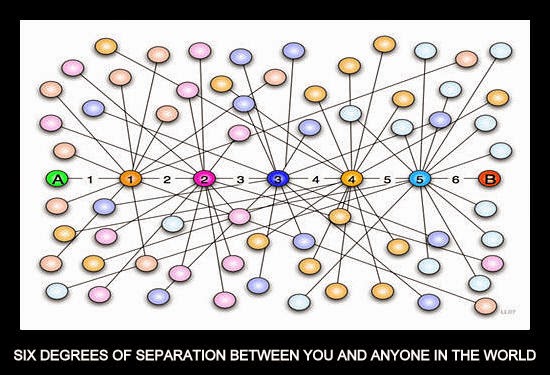
There is a theoretical maximum of only six persons (connections, similar to links in a chain) between you and anyone whom you'd like to meet in the entire world. Some quick background information follows:

Six degrees of separation is the theory that anyone on the planet can be connected to any other person on the planet through a chain of acquaintances that has no more than five intermediaries. The theory was first proposed in 1929 by the Hungarian writer Frigyes Karinthy in a short story called "Chains."

In the 1950's, Ithiel de Sola Pool (MIT) and Manfred Kochen (IBM) set out to prove the theory mathematically. Although they were able to phrase the question (given a set N of people, what is the probability that each member of N is connected to another member via k_1, k_2, k_3...k_n links?), after twenty years they were still unable to solve the problem to their own satisfaction. In 1967, American sociologist Stanley Milgram devised a new way to test the theory, which he called "the small-world problem." He randomly selected people in the mid-West to send packages to a stranger located in Massachusetts. The senders knew the recipient's name, occupation, and general location. They were instructed to send the package to a person they knew on a first-name basis who they thought was most likely, out of all their friends, to know the target personally. That person would do the same, and so on, until the package was personally delivered to its target recipient.

Although the participants expected the chain to include at least a hundred intermediaries, it only took (on average) between five and seven intermediaries to get each package delivered. Milgram's findings were published in Psychology Today and inspired the phrase "six degrees of separation." Playwright John Guare popularized the phrase when he chose it as the title for his 1990 play of the same name. Although Milgram's findings were discounted after it was discovered that he based his conclusion on a very small number of packages, six degrees of separation became an accepted notion in pop culture after Brett C. Tjaden published a computer game on the University of Virginia's Web site based on the small-world problem. Tjaden used the Internet Movie Database (IMDB) to document connections between different actors. Time Magazine called his site, The Oracle of Bacon at Virginia, one of the "Ten Best Web Sites of 1996."

In 2001, Duncan Watts, a professor at Columbia University, continued his own earlier research into the phenomenon and recreated Milgram's experiment on the Internet. Watts used an e-mail message as the "package" that needed to be delivered, and surprisingly, after reviewing the data collected by 48,000 senders and 19 targets (in 157 countries), Watts found that the average number of intermediaries was indeed, six. Watts' research, and the advent of the computer age, has opened up new areas of inquiry related to six degrees of separation in diverse areas of network theory such as as power grid analysis, disease transmission, graph theory, corporate communication, and computer circuitry.

If you'd like to try your own experiment with this, you can use a combination of a simple email message and your social media networks to launch a letter, which may go something like this:

“I have to get this urgent message to Mr. Barack Obama . Could you please forward this message to anyone who might know how to reach him as quickly as possible? Thanks in advance!

xxxxxxxxxxxxxxx

'Dear President Obama:

You may wish to give some serious thought to your current strategy and policy regarding negotiations with Iran. Things don't seem to be working out too well on their side of the purported bargain. Perhaps you may take a tougher stance on their nuclear power development and impose further constaints upon that country's potential proliferation with each further incident of sponsoring or aiding and abetting terrorism in the region. Would you please let me know your thoughts regarding this? I can be reached at http://bit.ly/CASTLEDIRECT.

Thank you for your consideration.

Respectfully,

Douglas E. Castle'

xxxxxxxxxxxxxxx

As always, thank you for reading me, and for maintaining, straining and training your mind with Braintenance.

Labels, Tags, Keywords, Categories And Search Terms For This Article:
Six Degrees Of Separation, Braintenance, networking, building contacts, Douglas E. Castle, Human connectivity, Kevin Bacon


Respond To Douglas E Castle
http://bit.ly/CASTLEDIRECT

BRAIN TEASERS,
BRAIN BOOSTERS &
COGNITIVE ENHANCEMENT!


FUNDING BUTTON LINK

BRAINTENANCE: Train, Strain And Improve Your Brain. Expand Your Mind.

http://braintenance.blogspot.com

Braintenance contains articles, resources, exercises, games and specially-designed protocols to improve the power of your brain and your mind in every significant aspect, including memory, cognition, IQ, plasticity, creativity and problem-solving ability.

Key Terms: brain, mind, cognitive enhancement, memory, brain gym exercises, IQ, plasticity, mind expansion, creativity, meditation, altered states, perception, self-hypnosis, self-growth, neuron, artificial intelligence, learning, somatic intellect, mathematics, language, dissonance, individualism, herd mentality, puns and word games, linguistics, genius, emotion, subconscious, unconscious, intuition, instinct, psychedelic, reality, learning curve, probability, collective consciousness

Saturday, March 21, 2015

The Nature Of Mind - BRAINTENANCE - Douglas E. Castle

Share this ARTICLE with your colleagues on LinkedIn .


Thinking about abstractions and examining cause-and-effect relationships are an integral part of intelligence strengthening. The more you utilize your introspective imagination, the greater your ability to conceptualize and to be creative. The mere notion of thinking about the nature of your mind, and of consciousness itself is a wonderful Braintenance exercise.  Give these questions some thought. Some of them require that you think about thinking -- a kind of recursive, "fractal logic":

Have you ever wondered about the nature of your mind? Is the mind separate from the brain or is the thinking, working mind merely a manifestation of the biological brain's self realization?

Do we imagine the existence of our minds?

Does the mind animate the brain? Or does the brain animate (or generate) the mind?

Are the brain and the mind somehow symbionts? Can one exist without the other? If the brain dies, does the mind die automatically?

Can consciousness, as we understand it, exist independent of biology?

Is the phenomenon of mental telepathy real? Is the phenomenon, when it seems to occur, a function of trained superconscious intuition or is it truly shared consciousness? Can we truly broadcast our thoughts and receive the thoughts of others?

Do our thoughts take on substance and live on independently of us? Do such entities as thoughtforms truly exist?

Is there truly a collective consciousness? If so, does it have embedded within it the thoughts of those long deceased? What is its origin (from where or what is it generated)? Does each of us contribute to it? Can any one of us access or "tap into" it? If so, how?

How are the subconscious, the conscious and the super conscious (intuitive) minds interconnected?

Are our minds a projection of someone else's thoughts or consciousness?

Is the mind truly located within the brain? Can the mind migrate and travel outside of the brain? Are astral projection, out-of-body and near-death-experiences genuine, or they more simply explained as a consequence of the chemistry of the brain?

Lastly, how often do you think about thinking?

The above photo bears no relevance to the subject matter of this article. Irrelevance is sometimes an intellectual virtue.

---------------

Thank you, as always for reading me.

Douglas E. Castle for The Braintenance Blog

Join Douglas E. Castle On Linked In => http://www.LinkedIn.com/in/douglascastle


Respond To Douglas E Castle
http://bit.ly/CASTLEDIRECT

BRAIN TEASERS,
BRAIN BOOSTERS &
COGNITIVE ENHANCEMENT!


FUNDING BUTTON LINK

BRAINTENANCE: Train, Strain And Improve Your Brain. Expand Your Mind.

http://braintenance.blogspot.com

Braintenance contains articles, resources, exercises, games and specially-designed protocols to improve the power of your brain and your mind in every significant aspect, including memory, cognition, IQ, plasticity, creativity and problem-solving ability.

Key Terms: brain, mind, cognitive enhancement, memory, brain gym exercises, IQ, plasticity, mind expansion, creativity, meditation, altered states, perception, self-hypnosis, self-growth, neuron, artificial intelligence, learning, somatic intellect, mathematics, language, dissonance, individualism, herd mentality, puns and word games, linguistics, genius, emotion, subconscious, unconscious, intuition, instinct, psychedelic, reality, learning curve, probability, collective consciousness

Monday, March 16, 2015

Analogies Are Mind Expanders: Braintenance - Douglas E. Castle

Share this ARTICLE with your colleagues on LinkedIn .


Analogies Are Mind Expanders

If you'd like to truly sharpen your ability to think associatively and to open up some exciting neural pathways in the bargain, doing exercises involving analogies may be just the think to add to your Braintenance regimen. These exercises even improve you pattern recognition, total cognition and creative thinking. If you'd like to think outside of the box (and keep your mind fresh in the process), analogies are wonderful tools.

An analogy (dog is to puppy as cat is to kitten, or, as it commonly appears on standardized tests, especially in higher grades: dog : puppy :: cat : kitten) is a comparison between two things that are usually thought to be different from each other, but have some similarities. They help us understand things by making connections and seeing relationships between them based on knowledge we already possess.

Analogies are a ubiquitous staple of standardized tests. This type of comparison plays a significant role not only in improving problem solving and decision making skills, but also in perception and memory, as well as communication and reasoning skills. Learning analogies can help with reading and building vocabulary.

Types of Analogies include:
  • Synonym (happy : joyful :: sad : depressed)
  • Antonym (inflation : deflation :: frail : strong)
  • Characteristic (tropical : hot :: polar : cold)
  • Part/Whole (finger : hand :: petal : flower)
  • Degree (mist : fog :: drizzle : tropical storm)
  • Type (golden retriever : dog :: salmon : fish)
  • Tool/Worker (pen : writer :: voice : singer)
  • Action/Object (fly : airplane :: drive : car)
  • Item/Purpose (knife : cut :: ruler : measure)
  • Product/Worker (poet : poem :: baker : pie)
    Different types of analogies are introduced at different levels. Elementary school analogies may be simple, possibly funny analogies; whereas middle school analogies may focus more on analogical reasoning. Analogies practiced in high school delve even more deeply into analogical problem solving.
    Analogy vs. Metaphor
    Students often confuse analogies with metaphors. Both are comparisons, often involving unrelated objects, so what IS the difference? An analogy is a parallel comparison between two different things, whereas a metaphor is more of a direct comparison between two things, often with one word being used to symbolically represent another. "All the world's a stage. And all the men and women merely players." is an example of a famous metaphor. William Shakespeare is directly comparing the world to a stage, with the people playing " roles" as they go about their daily lives. A comparable analogy would be "Players are to stage as figure skaters are to ice rink."
Practice
Here are some examples (without answers supplied, so if you are overly-challenged, you'll need to employ dictionary.com or some other vocabulary resource) of analogies to sharpen your mind and refresh your vocabulary as well... 


JUROR : JUDGE

Your answer:
criminal : sentence
umpire : oust
broom : sweep [this answer is correct]
decision : vacillate
doctor : cure

      1. AUTHENTICITY : COUNTERFEIT

Your answer:
reserve : reticent
mobility : energetic
anticipation : solemn
reliability : erratic
argument : contradictory

      1. TURTLE : REPTILE

Your answer:
snake : rattle
leaf : branch
oyster : clam
oak : tree
snail : shellfish

      1. AGENDA : CONFERENCE

Your answer:
man : woman
executive : employee
agency : assignment
teacher : class
map : trip

      1. EMBARRASS : HUMILIATE

Your answer:
labor : suceed
bicker : fight
reduce : enlarge
spank : whip
pilfer : steal

      1. COT : BED

Your answer:
hand : finger
hotel : motel
tissue : hankerchief
lesson : composition
tea : lemon

      1. CONCOMITANT: ACCOMPANYING

Your answer:
loyal : staunch
rough : texture
separate : attached
hard : granite
tanned : leather

      1. DISORGANIZED : SYSTEM

Your answer:
retired : hope
greedy : money
athletic : intelligence
traitorous : loyalty
conserve : party

      1. FIX : STABLE

Your answer:
mend : torn
fortify : strong
deter : active
captivate : attractive
furrow : productive

      1. INVARIABLE : CHANGE

Your answer:
unfathomable : depth
extraneous : proposition
incurable : disease
ineffable : expression
varied : appearance


I wish you the best of luck, fellow Braintenancers, and I thank you as always for reading me. 

Douglas E. Castle for The Braintenance Blog

Labels, Tags, Key Words, Categories And Search Terms For This Article:
Douglas E. Castle, neural, brain exercises, Braintenance, analogies, metaphor, associative thinking, pattern recognition, self-development, self-help, IQ

Respond To Douglas E Castle
http://bit.ly/CASTLEDIRECT

BRAIN TEASERS,
BRAIN BOOSTERS &
COGNITIVE ENHANCEMENT!


FUNDING BUTTON LINK

BRAINTENANCE: Train, Strain And Improve Your Brain. Expand Your Mind.

http://braintenance.blogspot.com

Braintenance contains articles, resources, exercises, games and specially-designed protocols to improve the power of your brain and your mind in every significant aspect, including memory, cognition, IQ, plasticity, creativity and problem-solving ability.

Key Terms: brain, mind, cognitive enhancement, memory, brain gym exercises, IQ, plasticity, mind expansion, creativity, meditation, altered states, perception, self-hypnosis, self-growth, neuron, artificial intelligence, learning, somatic intellect, mathematics, language, dissonance, individualism, herd mentality, puns and word games, linguistics, genius, emotion, subconscious, unconscious, intuition, instinct, psychedelic, reality, learning curve, probability, collective consciousness

Bookmark and Share